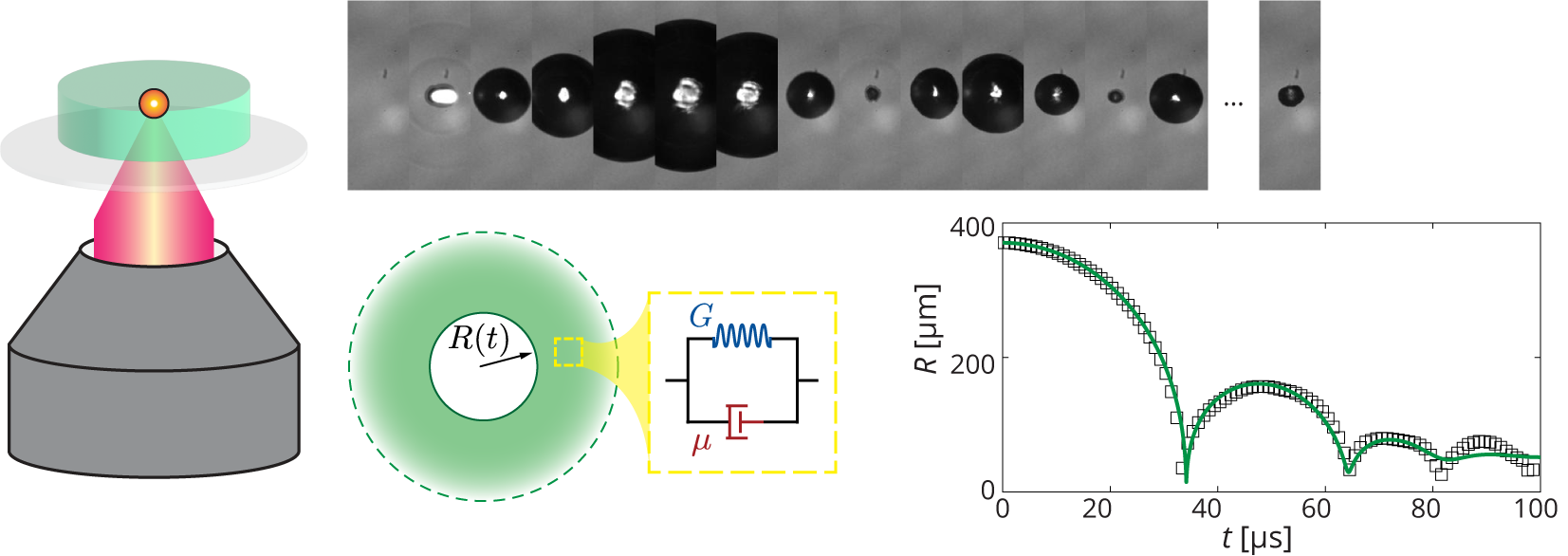
Inertial micro-cavitation rheometry (IMR) is a novel experimental technique that enables the characterization of soft material viscoelasticity at a high strain rate (103 – 108/s). What we learn from these experiments could be relevant to applications such as non-invasive laser- and ultrasound-based tissue surgery and the development of injury criteria and protective gears for blast mitigation.
I have been enhancing the theoretical and computational framework behind IMR to broaden its applicability. Our 2025 paper (see publication [3]) introduced an analytical model and an accompanying inverse characterization procedure to rapidly quantify viscoelastic model parameters according to the size-dependent scaling of bubble collapse time duing laser-induced cavitation experiments. This parsimonious procedure reduced the computational cost of the characterization process from hours to fractions of a second, creating the possibility to estimate material properties in real time.
Characterizing graded soft materials with cavity inflation
When considering cavity inflation, engineers have traditionally relied on the assumption of material homogeneity or an idealized arrangement of heterogeneity to preserve spherical symmetry in the analysis. In this project, we deliberately break the symmetry and ask: How does a cavity evolve when inflated in a material with non-radial mechanical gradation? Can the resulting cavity geometry reveal information about the mechanical gradation?
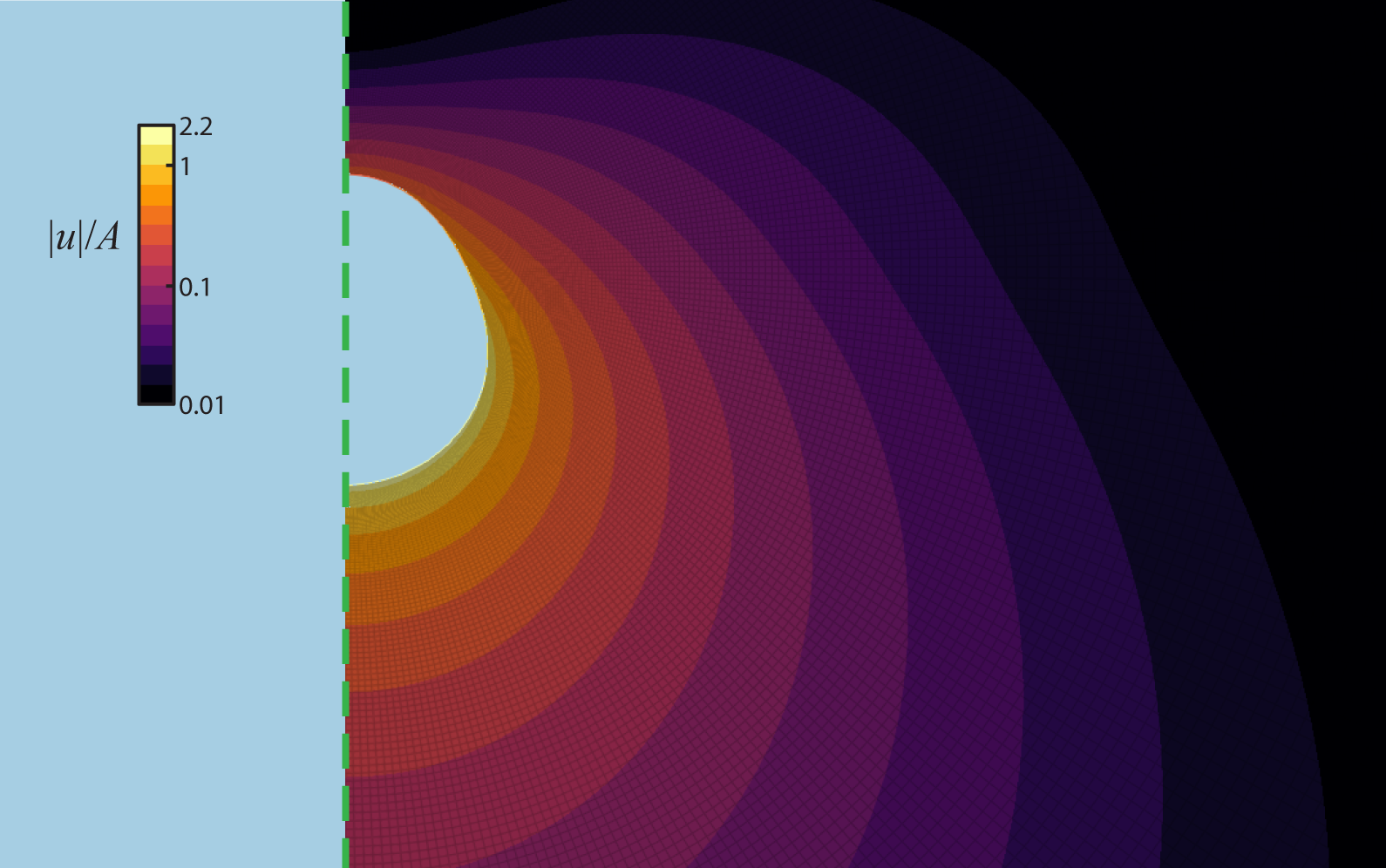
Our 2026 paper (see publication [7]) examined the quasi-static inflation of a pre-existing cavity in an incompressible hyperelastic solid whose shear modulus is graded monotonically along a reference Cartesian direction. As seen below in the displacement field from a representative finite-element simulation, the homogeneous cavity pressure causes the compliant side of the material to deform more than the stiff side, resulting in the migration of the cavity's centroid. Beyond an initial small-inflation regime, the centroid migration is much more prominent than any individual nonspherical Legendre mode of the recentered cavity surface. This observation motivated the development of a Rayleigh–Ritz reduced-order framework that predicts the migration amplitude for prescribed inflation levels and mechanical gradation parameters.
Building upon this theoretical advancement, I am now developing a practical procedure to inversely characterize graded materials using cavity inflation experiments.
Calibrating nonlinear elastic models via magnetic resonance cartography
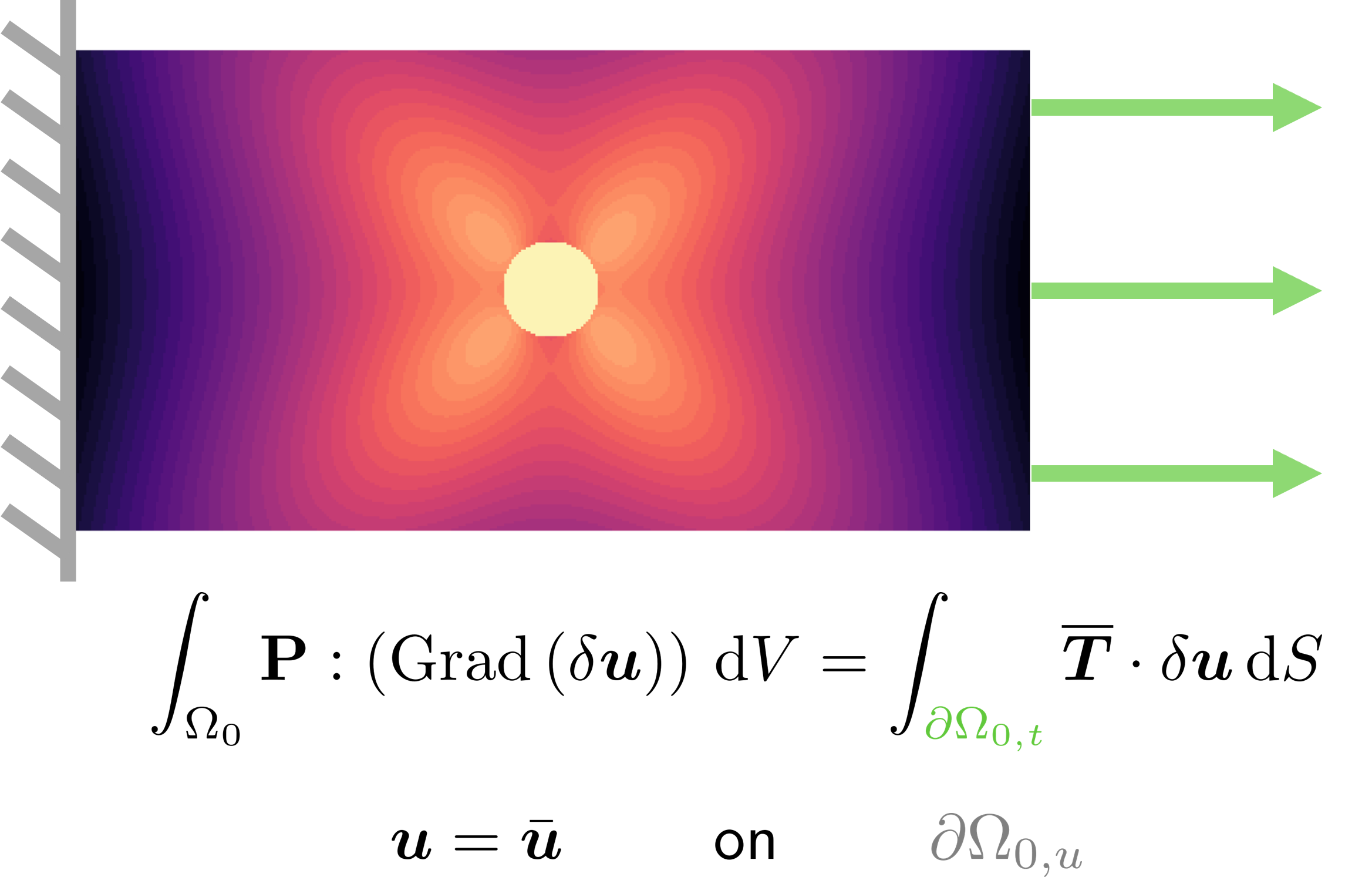
Magnetic resonance cartography (MR-u) collects fully three-dimensional displacement field data in a material experiencing finite deformation. It does not require the placement of fiducial speckle patterns or internal contrast fluorescent particles, as is the case for techniques such as digital image correlation (DIC) and digital volume correlation (DVC).
Our 2026 paper (see publication [4]) introduced a group of highly efficient and robust procedures to calibrate hyperelastic models according to the displacement field data collected by MR-u. I developed a variation-matching method that analytically identifies the optimal virtual displacement field to senstively identify constitutive model parameters via the principle of virtual work.